The System Works: Safe and Reliable Electrical Connections
Cable lugs are manufactured around the world, and each producer applies their own dimensional and material standards. Although cable lugs may be intended for the same cable cross-section, their dimensions can still vary significantly between manufacturers. This raises an important question: how can you ensure that the crimping connection you make is safe and reliable?
Installers and contractors may sometimes view the cable lug as a minor detail within a larger installation. However, if this component is not selected and installed correctly, the consequences can be costly. Incorrect terminations may cause faults, overheating or even damage, the repair of which may cost many times more than using the correct products from a single, unified crimping system from the beginning.
The most common crimping method used today for installing cable lugs is hexagonal crimping. In this method, the crimp stops when the dies of the crimping tool meet; the process does not continue even if the lug has not fully compressed around the conductor. For this reason, choosing the correct cable lug is essential: the internal and external diameters of the tube must be compatible with the crimping dies used in order to achieve a mechanically strong and electrically safe connection. Naturally, the dies must also match the crimping tool in use.
A unified crimping system as an internationally recommended solution
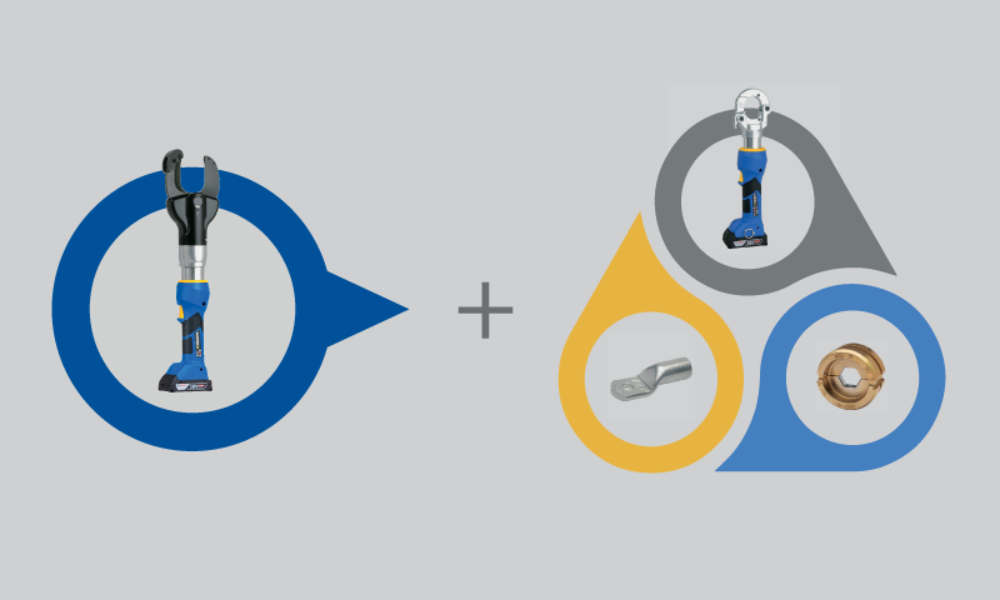
A safe connection is achieved when the cable lug, crimping dies and crimping tool all belong to the same crimping system. This approach is also internationally recognised, as full compatibility ensures consistent dimensions, tolerances and repeatability everywhere in the world.
Klauke manufactures all components of the system in-house, ensuring consistent quality and precise control throughout the entire material chain, from raw material to finished product. Crimping tools can also generate quality assurance reports for documentation and customer verification.
Klauke not only manufactures cable lugs and crimping tools, but also tests and confirms their mutual compatibility in accordance with the relevant standards. Quality assurance certificates are available for Klauke tools, demonstrating that they have undergone functional testing, force and pressure measurement, visual inspection and a final overall inspection. These documented processes support Klauke’s system philosophy: only a fully compatible and standards-tested system can guarantee a safe and long-lasting connection.
Crimping tools have developed significantly in recent years. Smaller size and lighter construction make work easier in confined spaces. Battery-powered crimping tools allow connections to be made at the press of a button, with built-in hydraulic pumps providing the required force smoothly and reliably. Battery technology makes it possible for a single installer to make crimping connections across a wide range from 0.1–1000 mm², whereas larger sizes previously required two people. As unnecessary work phases are reduced, the installer can focus on the actual task, which reduces errors and speeds up the work.
Since there are many different types of cables on the market, Klauke offers the possibility to verify the suitability of a crimping solution in advance. Tensile tests can be carried out on a crimping connection made with the customer’s cable in order to confirm to confirm the performance and quality of the crimping connection.