Motor Cables for Industrial Applications
Motor cables are used for power transmission between electric motors and variable frequency drives in industrial machinery and equipment. In these applications, the cable must provide reliable power transmission, good immunity to interference, and mechanical robustness in order to maintain system performance and operational reliability.

A motor cable is a dedicated cable type and should not be replaced with a standard control cable, even if the control cable has a rated voltage of 0.6/1 kV. Control cables are not structurally optimised for motor applications, which may affect system reliability. Motor cables are specifically designed for power supply between the variable frequency drive and the motor, where the electrical characteristics of the cable are particularly important.
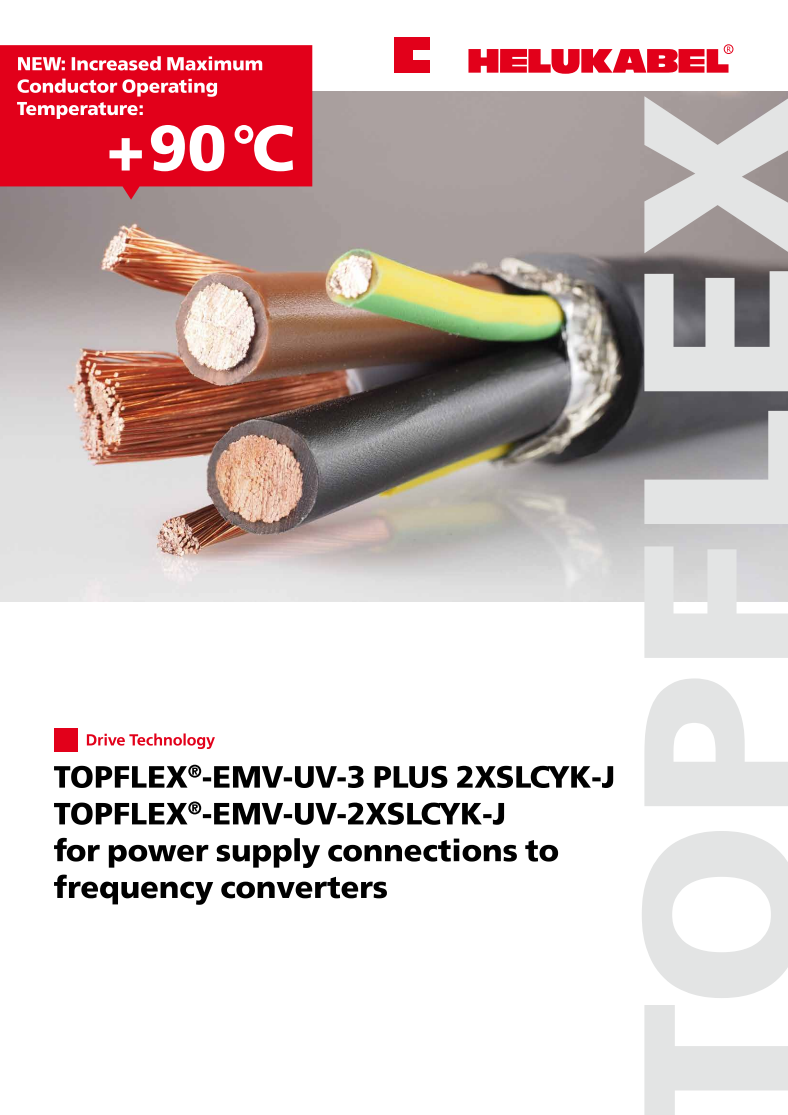
Motor cables are typically of four-core or symmetrical construction. In a symmetrical design, the protective earth conductor is divided into three sections, which reduces the overall cable diameter, lowers interference emission, and decreases the risk of earth conductor interruption. Motor cables use EMC double screening, consisting of aluminium foil and braided copper braid.
The outer sheath material and temperature rating influence the environments in which the cable can be used. PVC-sheathed options are available for indoor applications, as well as weather-resistant and UV-resistant versions for outdoor installation. Some motor cables are also suitable for direct burial. In addition, versions with higher temperature ratings are available, with operating temperatures up to +90 °C and increased current-carrying capacity.
Our product range includes HELUKABEL TOPFLEX® motor cables for industrial drive systems. The range offers multiple conductor constructions and sheath types, as well as halogen-free, IEC- and UL/CSA-approved versions. This makes it easier to select the right motor cable solution for different operating environments and installation methods.