What IP65, IP66, IP67, IP68 and IP69 Mean for Industrial Enclosures

Electrical equipment and its components are often exposed to dust, moisture, water and other environmental conditions. A correctly selected industrial enclosure protects equipment against these external influences and helps ensure reliable operation in different applications.
The protection level of an enclosure is described by its IP rating (Ingress Protection), which indicates how well the enclosure is protected against the ingress of water and foreign objects, such as dirt and dust. Although ratings such as IP65, IP66 and IP69 are familiar to many, their practical meaning is not always fully clear.
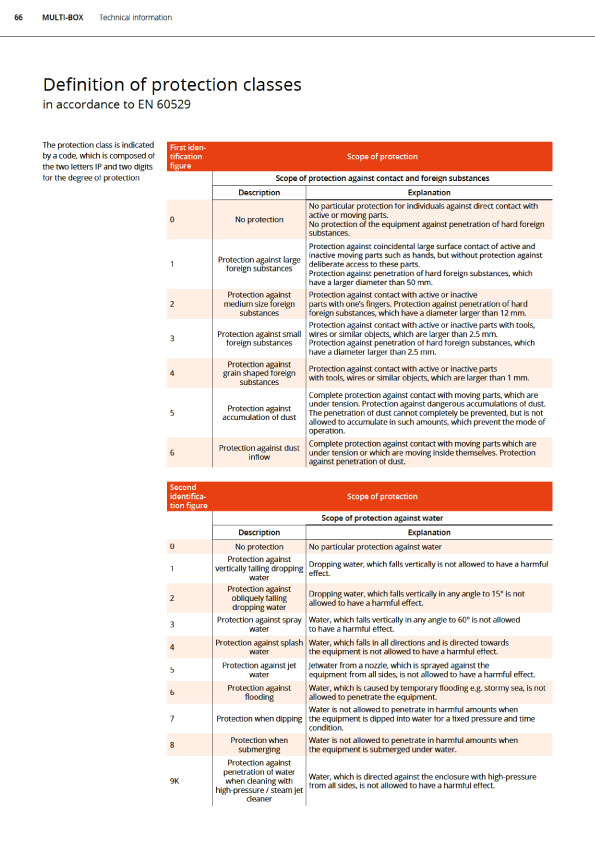
IP protection classes are based on international standards, such as DIN EN 60529 and ISO 20653. The IP code consists of two code digits. For example, in the IP66 rating, the first digit indicates protection against foreign objects, such as dust and dirt. The second digit indicates protection against water. The higher the number, the higher the level of protection achieved within that category.
Protection against dust and dirt
The first digit of the IP code describes the enclosure’s protection against foreign objects, such as dust and dirt. In industrial enclosures, protection classes 5 and 6 are among the most common.
- IP5X: The enclosure prevents dust from entering in harmful quantities.
- IP6X: The enclosure is dust-tight and prevents dust from entering under standardised test conditions.
In the dust protection test, the enclosure is placed in a dust chamber for a defined period of time. During the test, fine talcum powder is continuously stirred up inside the chamber, and a vacuum may be created inside the enclosure to simulate operating conditions. After the test, the enclosure is checked to ensure that no more dust has entered than is permitted for the protection class.
Protection against water
The second digit describes the enclosure’s protection against water. In industrial applications, the most common ratings include IP65, IP66, IP67, IP68 and IP69.
- IP65: Protection against jet water.
- IP66: Protection against powerful jet water.
- IP67: Protection against temporary immersion in water.
- IP68: Protection against immersion for a defined time and depth. The exact immersion depth and test duration are defined separately.
- IP69: Protection against hot high-pressure jet water.
In the water protection test, the enclosure is exposed to conditions defined by the relevant protection class. The tests may include jet water, complete immersion or hot high-pressure jet water. The test is passed if no water, or only a non-harmful quantity of water, has entered the enclosure.
An important note on IP protection classes

When interpreting IP protection classes, it is often assumed that a higher rating automatically includes all lower levels of protection. This is only partly true.
For protection against dust and dirt, a higher degree of protection automatically includes the lower degrees. For example, IP6X also fulfils the requirements of IP5X.
For protection against water, the situation is different. An enclosure with an IPX7, IPX8 or IPX9 rating does not automatically fulfil the lower degrees of water protection. Immersion tests and jet water tests are different test methods, so an enclosure may fulfil one requirement without fulfilling the other. For this reason, enclosures may also carry a double marking, such as IP66/IP67, when both protection levels have been tested separately.
What does an IP rating not tell you?
An IP rating is an important tool when selecting an enclosure, but it does not alone determine whether a product is suitable for a specific operating environment.
Protection class testing does not, for example, take ageing into account or guarantee that the protection class will be maintained unchanged throughout the entire service life of the product. Temperature changes that may occur outdoors are also not covered by IP protection class tests.
Strong temperature changes can lead to negative pressure inside the enclosure, causing moisture to be pulled inside through the sealing. In such applications, pressure compensation elements can be used to help reduce moisture formation inside the enclosure.
The right protection class for the application
The appropriate IP protection class always depends on the requirements of the operating environment. Exposure to dust, moisture, water, cleaning processes or temperature changes affects the level of protection required.
MULTI-BOX industrial enclosures are available in various IP protection classes, allowing a suitable level of protection to be selected according to the requirements of the application and environment.