What to Consider When Choosing a Safety Controller
The implementation of functional machine safety is increasingly based on programmable safety controllers. They form a central part of the machine’s safety-related control system and ensure that safety functions operate reliably in all operating conditions. The right safety controller has a direct impact on the achievable safety level, system scalability, diagnostics, and the total cost of ownership over the machine’s lifecycle.

A safety controller is not just an I/O device, but a complete system combining safety performance, programming, diagnostics, communication, and expandability. The first and most important starting point when selecting a safety controller is the required safety level. The controller must support the Performance Level defined by the risk assessment according to ISO 13849-1, or the Safety Integrity Level according to IEC 61508 and IEC 62061. In addition, it must comply with the requirements of the European Machinery Directive and be suitable for CE-marked machinery.
Certification alone is not sufficient. The safety controller must also fit the machine architecture and future development needs. A modular design allows the system to be expanded by adding I/O or communication modules as the application grows, without replacing the entire control system. This is particularly important for machines that are developed in stages or offered with different configuration levels.
The programming environment has a major influence on commissioning efficiency and risk of errors. Graphical programming and ready-to-use function blocks simplify engineering, while simulation and documentation functions support testing, validation, and later modifications.
In modern machines, a safety controller rarely operates as a completely standalone system. Therefore, support for common fieldbuses and Ethernet-based networks is essential. The controller must be able to communicate with the machine PLC and HMI, for example to exchange status information and diagnostics. At the same time, I/O capacity must be sufficient for both current and future requirements.
Diagnostics and maintenance directly affect machine availability. Clear LED indicators, detailed fault messages, and condition monitoring enable fast troubleshooting. Remote diagnostics and event logging help identify recurring issues and support predictive maintenance.
From an installation perspective, the physical size of the safety controller, terminal technology, and environmental resistance influence control cabinet design. A narrow form factor saves space, and spring-clamp terminals speed up wiring. The operating temperature range, vibration resistance, and IP rating determine whether the device is suitable for harsh or decentralised installation environments.
Manufacturer support and the surrounding ecosystem are also important. Good documentation, training opportunities, and long-term product availability make the system easier to use throughout its entire lifecycle. A safety controller is rarely a short-term investment, but a core part of the machine for many years.
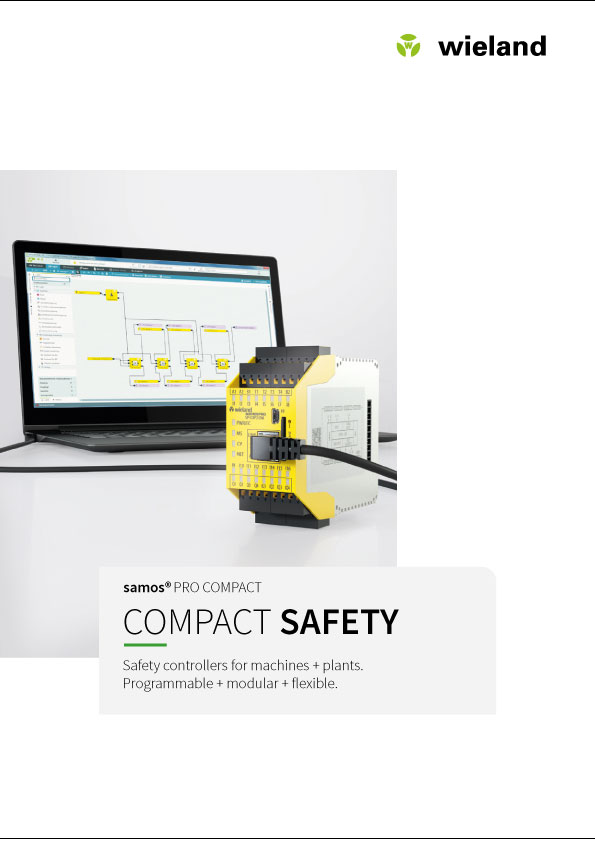
Wieland Electric’s samos® PRO safety controller system is designed for modern machinery safety applications requiring high safety performance, flexibility, and scalability. The system supports SIL 3, Category 4, and PL e applications in accordance with EN ISO 13849-1 and EN 62061. Its modular architecture allows the system to be expanded as the application grows. Programming is carried out using the free samos® PLAN6 software, which offers graphical programming as well as simulation and testing functions. The base module supports common Ethernet-based protocols such as PROFINET, EtherNet/IP, and Modbus TCP, and its compact design is well suited for space-constrained control cabinets. Wieland also provides documentation and support materials to assist commissioning and lifecycle operation. For more information about Wieland Electric safety controllers: www.wieland-electric.com/safety-controller/
Summary
Selecting a safety controller is a holistic decision where safety performance, scalability, programming, communication, and usability go hand in hand. A carefully chosen safety controller supports both machine safety and long-term production efficiency.